

Built for public-sector teams
Protect sensitive public-sector files with confidence.
AxCrypt helps agencies, departments, and public-sector partners secure reports, citizen records, policy documents, and interdepartmental collaboration.
- Encrypt reports, records, and policy drafts
- Share securely with departments, agencies, and partners
- Protect files containing citizen information
- Support controlled access without heavy complexity



Uitdaging in de industrie
Public-sector work requires collaboration and careful stewardship.
Sensitive reports, citizen records, and department files need to move between teams without becoming exposed. AxCrypt keeps protection close to the file.
Without proper encryption
- Sensitive reports move through unprotected channels
- Citizen data is copied across shared folders
- Partner collaboration creates exposure
- Access ownership becomes unclear
With AxCrypt
- Files are encrypted before sharing
- Only approved users can decrypt them
- Protected files work across storage tools
- Teams keep control as documents move
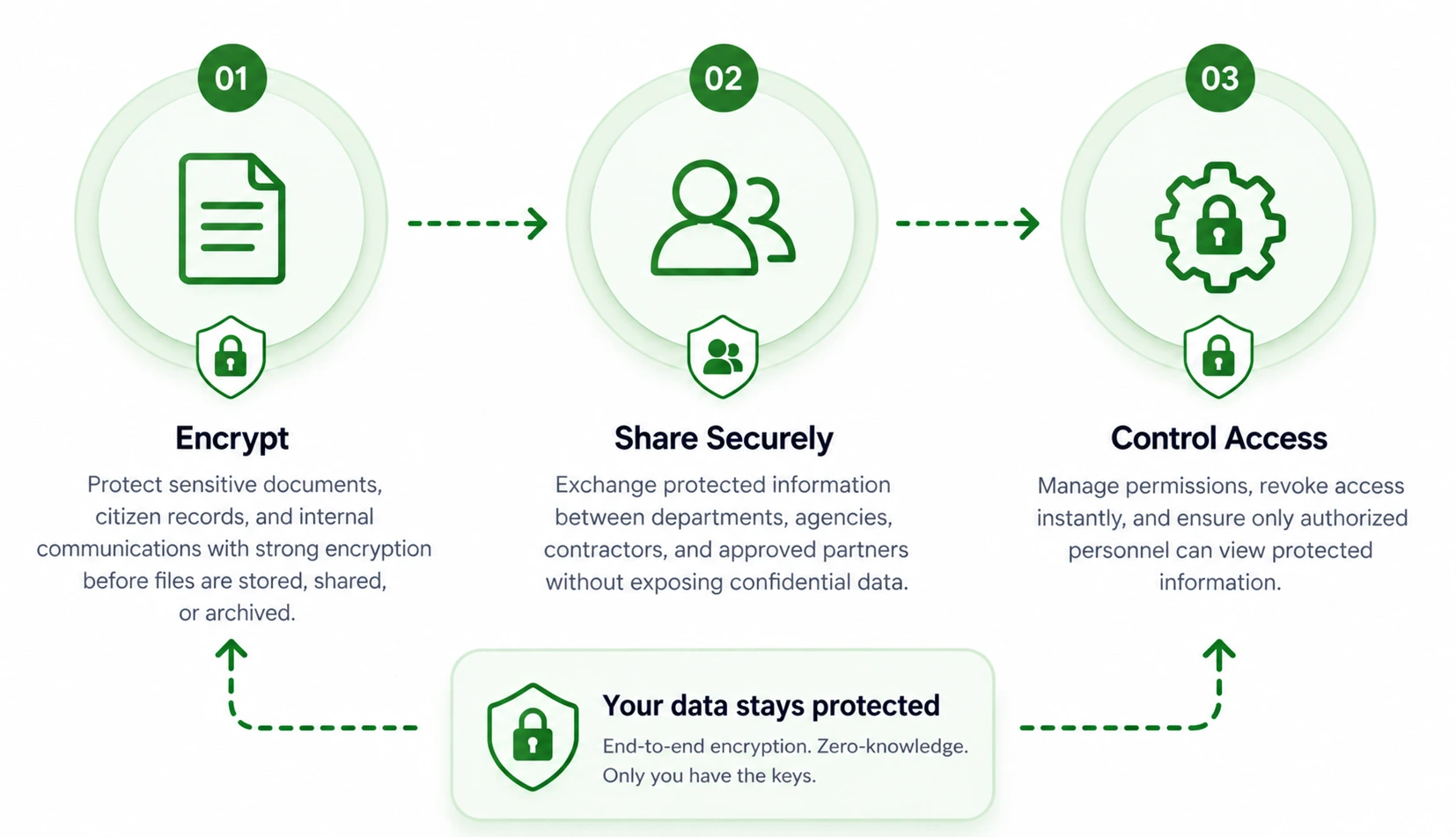
Hoe AxCrypt werkt
3 simple steps, from local government offices to national agencies.
Gebouwd voor uw werk
Protection across every government workflow

Agency Records
Protect citizen records, forms, and sensitive administrative files.
Confidential Reports
Encrypt policy drafts, operational reports, and internal documents.

Interdepartmental Sharing
Share protected files between teams, departments, and agencies.
Partner Collaboration
Secure documents shared with contractors and approved stakeholders.
Audit Evidence
Protect compliance documentation and security evidence packages.
Cloud Storage
Keep sensitive public-sector files encrypted in sync folders.
Cloudintegraties
Werkt waar uw team werkt
Versleutel bestanden voordat ze worden gesynchroniseerd via de tools die uw team al gebruikt.


Compliance waarop u kunt vertrouwen
Built for the frameworks public-sector teams already answer to.
Support security and privacy expectations for sensitive public-sector records and collaboration.
FIPS
Support public-sector encryption expectations.
GDPR
Protect personal data with practical file security controls.

ISO 27001
Support information security management practices.
SOC 2
Strengthen controls around sensitive customer data.
CCPA
Help protect consumer privacy in shared files.
Zero Knowledge
Only approved users can decrypt protected files.
Succesverhaal
How public-sector teams protect shared records.
A department needed a practical way to encrypt sensitive reports and citizen-related files before sharing them with internal teams and external partners.

Resultaten
Trusted by teams responsible for sensitive public data.
"AxCrypt gave our team a simple way to protect shared records."
"Secure file sharing became much easier for department collaboration."
"The workflow is simple enough for everyday public-sector use."
Waarom teams voor AxCrypt kiezen
Because security controls don't follow government files.
| Traditional Government Security Tools | AxCrypt |
|---|---|
| Complex deployment | Deploy in minutes |
| Difficult for non-technical users | Simple enough for every team |
| Separate sharing tools | Secure sharing built in |
| Heavy IT involvement | Minimal administration overhead |
| Unclear file ownership | Controlled access and revocation |
Vragen
Veelgestelde Vragen
How can AxCrypt help government agencies protect sensitive files?
AxCrypt provides file-level encryption for confidential government documents before they are stored, transferred, or shared, including contracts, procurement files, financial records, citizen information, engineering drawings, project documentation, and internal reports.
How can municipalities securely share confidential documents?
Municipalities can encrypt sensitive files before sending them to employees, contractors, consultants, suppliers, or other government organizations while continuing to use existing email, cloud storage, and collaboration systems.
How can government departments encrypt files without complex IT infrastructure?
Departments can use file-level encryption to protect individual documents inside normal document management and file-sharing workflows, which helps smaller public-sector teams strengthen security without a large infrastructure project.
What is the best way to securely share government documents with contractors?
Encrypt confidential documents before sharing them with contractors and external partners so contracts, specifications, procurement documents, technical drawings, and financial information remain protected after they leave the organization.
How can government agencies protect confidential files sent by email?
Agencies can encrypt documents before attaching them to email. This protects the file itself rather than relying only on the security of the email channel.
How can government organizations protect sensitive documents stored in cloud storage?
Government teams can encrypt sensitive files before uploading or sharing them, adding protection to documents stored in shared folders and cloud-based collaboration environments.
How can government agencies protect citizen and public records?
Agencies can encrypt files containing personal, financial, administrative, or confidential information before storing them locally, transferring them between departments, or sharing them with approved external organizations.
How can government departments protect procurement and tender documents?
Procurement teams can encrypt files containing bids, supplier information, pricing, contracts, evaluation documents, and tender specifications before storage or exchange.
How can government organizations secure engineering drawings and infrastructure plans?
Engineering drawings, architectural plans, infrastructure designs, technical specifications, and project documentation can be encrypted before they are shared with departments, engineering firms, consultants, construction companies, or contractors.
How can government agencies protect financial and accounting documents?
Agencies can encrypt budgets, invoices, payroll documents, financial reports, audit records, procurement information, and accounting files before storing or sharing them with auditors, suppliers, accountants, and other authorized parties.
How can government employees securely work with sensitive files remotely?
Remote employees can encrypt confidential documents before storing, transferring, or sharing them outside the office, helping protect files on laptops, home networks, and cross-department workflows.
How can government agencies protect documents when collaborating across departments?
Departments can encrypt sensitive legal, financial, procurement, policy, administrative, and technical documents before moving them between teams that may use different systems or storage environments.
How can government organizations protect intellectual property and technical information?
Government organizations can encrypt engineering drawings, research data, technical specifications, software documentation, project plans, and infrastructure designs before sharing them with contractors, consultants, suppliers, and external partners.
What types of government documents should be encrypted?
Documents containing confidential, personal, financial, legal, operational, procurement, or intellectual-property information should be considered for encryption, including citizen records, contracts, tenders, budgets, infrastructure plans, internal reports, legal documents, and sensitive correspondence.
How can small government agencies improve data security without a large cybersecurity team?
Small agencies can start with practical file encryption for high-risk documents, strengthening confidential document protection while keeping existing IT and collaboration workflows largely unchanged.
How can government agencies protect sensitive documents and files?
A practical workflow is to identify sensitive documents, encrypt them at the file level, restrict access to authorized personnel, and use secure processes when sharing files with employees, contractors, suppliers, and other public-sector organizations.
Protect public-sector trust with every file.
Secure sensitive records, reports, and department files before they move.