

August 26, 2026
Simplifying Compliance: File Encryption as Your First Line of Defense for GDPR, HIPAA, and NIS2
Sometimes people underestimate or sideline data compliance.
For most, it remains a checkbox rather than a concern.
And ever since the GDPR came into force, companies that fail to protect people's personal data have faced billions of euros in fines. Two of the most trusted reports tracking GDPR enforcement show just how significant these penalties have become.
According to DLA Piper's January 2026 GDPR Fines and Data Breach Survey, regulators have issued around €7.1 billion in fines since the law took effect. Meanwhile, the CMS GDPR Enforcement Tracker, which counts publicly reported cases, recorded €6.11 billion in fines across 2,685 enforcement cases by March 2026.
Although the totals differ because each report uses a slightly different method for counting fines, both highlight the same trend: regulators are actively enforcing GDPR, and organisations that fail to comply can face substantial financial penalties.
That is just GDPR alone.
HIPAA violation statistics for 2026 show three important numbers: 374,322 complaints filed with the HHS Office for Civil Rights since 2003, 7,419 healthcare data breaches reported since 2009, and $2,190,294 as the current yearly limit for one type of civil penalty.
Hacking and IT incidents cause nearly every large HIPAA breach in healthcare organizations; ransomware is now common in HIPAA enforcement, and most reported breaches involve hacking. Healthcare data breaches have affected more than 2.5 times the US population cumulatively.
HIPAA-covered entities face stricter breach notification requirements and closer scrutiny of business associates than ever before.
But the lesson extends well beyond healthcare: when sensitive files move across teams, vendors, devices, and cloud apps, every organisation carries the same exposure to regulatory, financial, and reputational fallout.
That is what this problem means in practical terms, and it points to a simple starting point for reducing risk: protect the data itself before a breach occurs.
This article explores how file encryption is the first line of defence and how in the event of a breach or compliance violation, file encryption tools like AxCrypt can become a critical safeguard for limiting exposure and proving that sensitive data remained protected.
What these regulations are really trying to protect?
Although GDPR, HIPAA, and other compliance frameworks differ in scope and application, they are built around the same core objective: protecting sensitive information from unauthorised access, misuse, loss, and breach. At their foundation is a clear expectation that organisations must secure data wherever it is stored, shared, or transferred.
This is where file-level protection becomes an essential compliance safeguard. By securing individual files with AES-256 encryption, strong key management, and a zero-knowledge architecture, organisations can reduce the potential impact of a breach and better meet the security expectations set out in modern data protection regulations.
Article 32 of the EU General Data Protection Regulation (GDPR) and the HIPAA Security Rule (45 CFR Part 164, Subpart C) both require organisations to implement appropriate technical and organisational safeguards based on risk. While GDPR is a broad European privacy law and HIPAA is specific to healthcare in the United States, both emphasise the importance of encryption, access controls, system resilience, and the ongoing protection of sensitive data.

An AxCrypt approach and practical 5-step implementation checklist:
Encryption works best when it is part of a clear, repeatable process, not a one-time task. Use the following checklist to apply file-level protection consistently across sensitive data, shared systems, and compliance workflows.
1. Identify high-risk data: Locate files that contain personal information, electronic health records, payroll records, financial statements, customer databases, and confidential business documents.
2. Classify files by sensitivity: Group data by risk level so teams understand which files need the strongest protection and which can follow standard security controls.
3. Apply AES-256 file encryption: Encrypt sensitive files and folders stored in cloud platforms, shared drives, email attachments, and removable media. File-level encryption protects the data itself, so security travels with the file even when it leaves the original device.
4. Control access and keys: Use strong key management and least-privilege access so only authorised users can decrypt sensitive files. Review permissions regularly to keep access accurate and secure.
5. Document controls for audits: Record what is encrypted, who has access, how keys are managed, and how the process is tested. This creates reusable evidence for GDPR, HIPAA, and NIS2 compliance while keeping encryption consistent across the organisation.
Tools such as AxCrypt can support this approach by helping organisations protect files across cloud storage, email, and collaborative workflows without adding unnecessary complexity for employees.
Bringing It All Together,
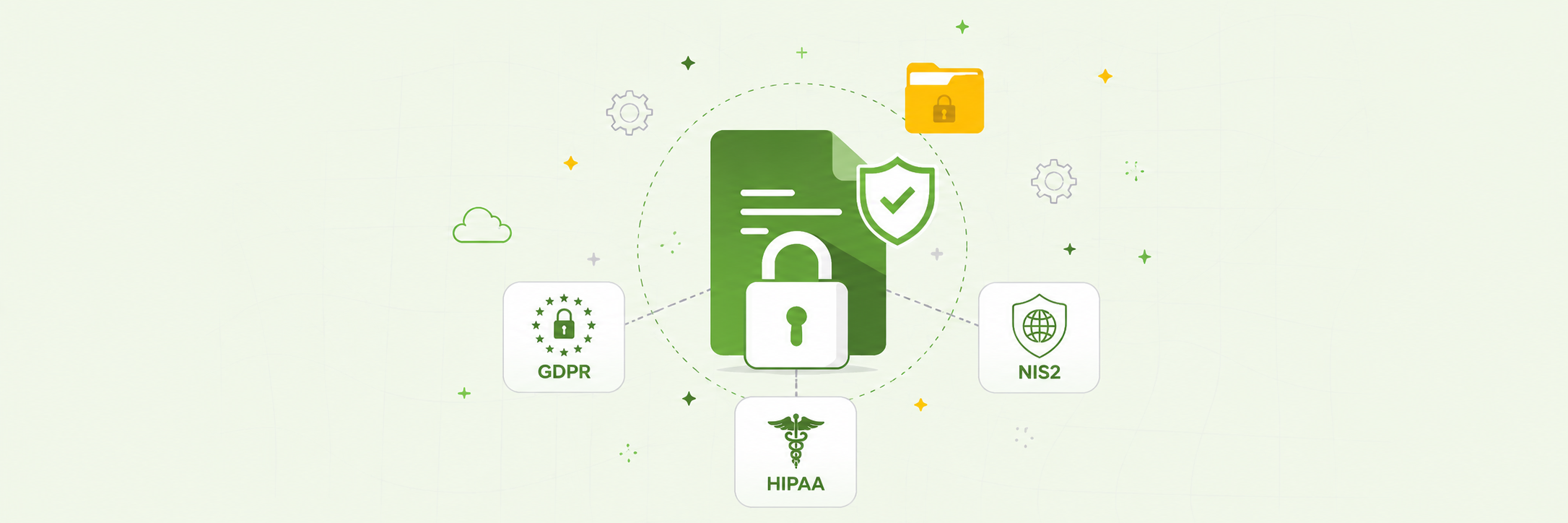
GDPR, NIS2, and HIPAA may each have different requirements, but they all point to the same responsibility: organisations must protect sensitive information from unauthorised access, disclosure, and misuse. Compliance cannot be solved by a single product, but it does require the right controls working together as part of a wider security strategy.
That is why AxCrypt should be treated as more than a file encryption tool. It should be added to the organisation’s security stack and built into everyday data protection protocols, especially wherever sensitive files are stored, shared, emailed, or accessed across cloud and hybrid environments.
With AES-256 encryption, strong key management, least-privilege access, and a zero-knowledge approach, AxCrypt helps make file-level protection practical, scalable, and easy for teams to adopt. Adding AxCrypt to your security measures strengthens your first line of defence, reduces compliance exposure, and ensures sensitive data remains protected even when files move beyond your direct control.
FAQs
1. Does GDPR require file encryption?
GDPR does not require file encryption in every situation, but Article 32 explicitly lists encryption as an appropriate technical measure for protecting personal data. Organisations are expected to implement security controls that are proportionate to the risk, and encryption is widely recognised as one of the most effective ways to reduce exposure if personal data is lost, stolen, or accessed without authorisation.
2. Is encryption mandatory under HIPAA?
Under the current HIPAA Security Rule, encryption of electronic protected health information (ePHI) is considered an addressable safeguard, not an automatic requirement. However, healthcare organisations must implement it when it is reasonable and appropriate or document an equivalent alternative. Regulatory expectations continue to move toward stronger encryption practices for data at rest and in transit.
3.Does NIS2 compliance require encrypted files?
NIS2 does not require every file to be encrypted in every situation. Instead, Article 21 requires essential and important entities to implement proportionate and appropriate cybersecurity risk-management measures, including policies on the use of cryptography and, where appropriate, encryption. Encrypting sensitive and business-critical files, such as financial records, security documentation, customer data, and incident-response materials, can strengthen confidentiality, integrity, access control, and resilience while helping organisations reduce the impact of a cyber incident and demonstrate compliance with NIS2.
4. What is the difference between file-level encryption and full-disk encryption?
Full-disk encryption protects the entire device when it is powered off, while file-level encryption protects individual files and folders even when they are copied, emailed, synced to the cloud, or stored on removable media. For compliance and data-sharing scenarios, file-level encryption often provides more granular and portable protection.
5. Can encryption reduce breach notification obligations?
In some cases, yes. If encrypted data is rendered unintelligible to unauthorised individuals, regulators may consider the risk to affected people significantly lower. Under GDPR, this can influence whether data subjects need to be notified, although the final determination depends on the circumstances of the breach and the quality of the encryption implementation.
6. What type of encryption is considered strong for compliance?
AES-256 encryption is widely recognised as a strong modern encryption standard and is commonly used in enterprise, healthcare, financial, and government environments. The strength of encryption also depends on proper key management, secure implementation, access controls, and user authentication, not just the algorithm itself.
7. Can one encryption strategy help with GDPR and HIPAA?
Yes. A well-designed file-level encryption strategy can support both GDPR and HIPAA because they share core security goals: protecting sensitive data, limiting unauthorised access, maintaining data integrity, and reducing the impact of security incidents. GDPR requires appropriate technical and organisational measures based on risk, while HIPAA requires covered entities and business associates to protect electronic protected health information through appropriate safeguards. Encryption alone does not guarantee compliance, but it can provide a consistent, auditable control and reduce the operational burden of meeting both frameworks’ requirements.
Strengthen Compliance with File-Level Encryption!
Compliance gaps and data breaches can happen even with strong policies in place. AxCrypt helps organisations add practical file-level encryption to their security stack, so sensitive data stays protected when it is stored, shared, emailed, or accessed across different environments. Build stronger breach readiness and support your compliance efforts with encryption that fits into everyday workflows.
- Protect sensitive files: Apply AES-256 encryption to confidential documents before they move across devices, cloud apps, or teams.
- Support compliance controls: Strengthen data protection measures for GDPR, HIPAA, SOX, and other regulatory requirements.
- Reduce breach exposure: Keep file-level protection in place even when files leave your direct control.
View Pricing | Explore Features | Download AxCrypt
Get started today!


